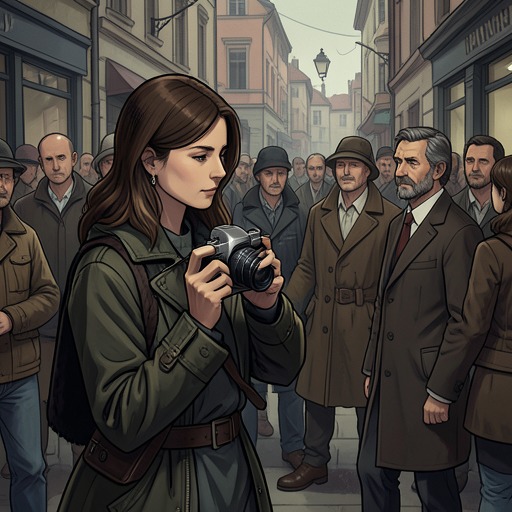
Coutney Crimson's home
Thirteen Reasons WhyCourtney Crimsen’s house is the setting of the party where Hannah Baker encounters Bryce Walker in a redwood hot tub. The house matters not simply as a venue: its fence, gate, and secluded yard shape Hannah’s discovery of the scene, while the party’s social ease gives way to an assault that she later struggles to name and a response that offers her starkly limited choices.
Setting and Arrival
Hannah identifies Courtney’s house as the site of the party, while clarifying that Courtney had already left when the events she is about to describe began. Hannah turns away from the house, apparently leaving the gathering behind, but Bryce calls to her from over the tall wooden fence at its side. His head appears above the barrier, and he asks where she is going. The fence marks a boundary, but it does not close off the encounter: Bryce’s call redirects Hannah back toward the property and toward what follows.
The party’s setting is not presented as a single room or a general crowd. Hannah crosses wet grass and pulls the latch on a gate, opening it only a few inches. Through this narrow opening she sees a redwood hot tub, with steam rising above it. The jets are off; water laps against the sides and against the two people inside. That small, deliberate act of opening the gate makes the yard’s privacy visible as something Hannah has to cross into, rather than a scene already placed openly before her.
The Hot-Tub Encounter
Inside the hot tub, Bryce and Courtney rest their heads against its edge with their eyes shut. Their small smiles, the steam, and the quiet water initially give the scene an inviting appearance. Hannah’s description holds that surface calm alongside what happens next: she recounts that Bryce touched her, that she turned her head, clenched her teeth, and fought back tears, and that he saw her distress. He told her to relax. Hannah stresses that she did not say no or push his hand away, but her account also makes clear that this absence of an explicit refusal did not mean she was at ease or unaffected.
Hannah says that she needed Bryce in that moment so that she could let go of herself, and describes herself as using him even as he touched her. That framing does not make the encounter simple or resolve the question of consent; instead, it conveys her distress and disconnection from her own responses. She recounts that Bryce continued, moving from touching her waist to sexual contact and not stopping there. When he was done, she got out of the hot tub and walked two houses away. Her abrupt departure marks the end of the night as she tells it, but not the end of its consequences.
From the Scene to a Question of Assault
The hot tub becomes central to Hannah’s later attempt to understand what happened. In a conversation with Mr. Porter, she is asked whether anything with the boy might be considered illegal. Hannah answers that she does not think it was rape, then asks why she cannot know. The question matters because her own account describes distress that Bryce observed and conduct that continued, while her later answer remains uncertain about how to classify the encounter. The text presents that uncertainty rather than supplying a legal ruling.
Mr. Porter offers two possible responses: confronting Bryce and discussing what happened at the party, or moving on. Hannah’s recollection of the question and these alternatives connects the secluded yard to an institutional conversation about what can be done afterward. The house is thus the setting of both the encounter and the account’s unresolved problem: what Hannah experienced, how she understands it, and what response is available to her.
Memory, Boundaries, and Consequences
Other memories associated with the house sharpen its significance. Hannah recalls a moment when she told Clay Jensen to stop and her hands stopped pulling him in; Clay pushed his hands against her chest. In another recollection, she stands with one hand on a bed for support, sees the shadow of shoes beneath a door, and starts toward the light before noticing two more shoes and stopping. These fragments do not establish that the bedroom is at Courtney’s house, and they should not be conflated with the hot-tub scene. They do, however, place questions of stopping, bodily boundaries, and interrupted movement alongside Hannah’s account of the party.
The house’s spatial details give the party a particular narrative shape: the public fact of a gathering, a turn away from the property, Bryce appearing above the fence, and Hannah opening a gate onto a quiet, enclosed hot tub. Against the inviting surface of water and steam, Hannah recounts distress and continued sexual contact, then leaves the yard and walks away. In her later conversation with Mr. Porter, uncertainty about whether the encounter was rape meets the limited alternatives he proposes. Courtney’s house therefore anchors a consequential episode without resolving the questions it raises about consent, responsibility, and the adequacy of the response.